
Sunday, October 7, 2018

Saturday, October 6, 2018

Friday, October 5, 2018
They Saved The Art!
 When I took French back in high school, I remember the teaching stating that the people of France hid the art from the Louvre through World War II so Germany could not appropriate it as they did the art from the Jews and others.
Imagine, a nation worked together to hide precious art work from invaders for several years to preserve their heritage. The struggle began in 1938, when the French government realized they were facing the possibility of being overrun.
So beginning in 1938, workers of the Louvre prepared paintings, and sculptures before sending them out to chateaux and other places in the countryside. They chose nondescript locations that the Germans would never think to look.
In 1939, just a few days before the Germans invaded, the Mona Lisa left the Louvre for a safe place. It would be moved five times during the war to keep it safe but they did it. In fact, when France and Britain declared war on September 3, 1939, the workers made a concerted effort to remove all remaining major artworks so as to protect them.
Jacques Jaujard took it upon himself to prepare the art to leave the Louvre. He closed the museum for three days so necessary repairs could be done but in reality, he, his staff, students, and others worked round the clock to pack up all the public art after they classified the art as most valuable art, major works, and world treasures.
One of the workers secretly recorded every painting confiscated from private citizens so that when the war ended these records were used to repatriate over 45,000 paintings from the Germans. Throughout the war, he kept track of all the artwork, even going to far as to smuggle heaters as needed to help preserve everything.
They packed up over 3,600 paintings, multiple sculptures, and other pieces of artwork, dispatching them in 37 convoys across the countryside. One convoy had 203 trucks carrying over 1800 pieces alone. These convoy's traveled roads packed with refugees escaping Paris. Although these pieces of art were protected from the Germans, they decided the Louvre should be reopened one year later in September of 1940 to maintain the normalcy of the city.
Unfortunately, when the Louvre reopened, the Germans slowly filled the museum with art they confiscated from the conquered before sending it on to Germany. Many wings were closed due to a lack of art while at least one other wing housed art that only the Germans could view. The head of the museum and his workers were unable to do anything to save that art at this time.
In addition to keeping the art safe from the Nazi, he had to fight the Vichy French government who wanted to turn all the art over to the German Government. Throughout the war he managed to keep that from happening. Once the war ended, the French Government had to repair the Louvre, get the paintings back and by 1947, the museum reopened with every one of the pieces of art that had been shipped out in 1939.
It is so impressive that the people of France banded together to save these pieces of art for future generations. Let me know what you think, I'd love to hear. Have a great day.
Thursday, October 4, 2018
Museums? When and Where Did They Start.
 When was the last time you visited a museum? Was it an art museum such as the Louvre or the Guggenheim? Or did you get to wander through one of the numerous Museums of Science and Technology?
The last museum, I wandered through was the Bishop Museum in Honolulu. I went because they had a visiting dinosaur exhibit but they also had a kids section and a section filled with Polynesian artifacts. I spent a whole day there and had a blast.
Have you ever wondered how long museums have been around? When did they start? For most of us, they were always around. I remember seeing those museums at small hole in the road places you'd stop for gas when traveling cross country. It might house arrowheads or old animal skeletons but they attracted people. There is even one in London devoted to death and medicine which I saw with a friend who made a promise to a dying man.
The word Museum came from a Latin word that evolved from the Greek word for Muses. Since Museums are places where items are cared for and displayed so the concept has been around for a very long time, at least since the Sixth century when a Babylonian Princess collected and curated items from Mesopotamia. This collection was discovered in 1925 by an archeologist who noted that items had notes of where they were from. This is thought to be the first real museum.
From then on, museums existed but in reality the collections belonged the royalty or the rich who kept them private, never to be seen by the average man. Eventually, families began donating these collections to the state but the first "public" museum appeared in 1683 when John Tradescant opened his "Curiosity Cabinet". He built the first building dedicated strictly to art. It was another 50 years or so before governments began building public museums.
The British Museum began in 1759 while the Louvre opened in 1793. The Louvre opened due to a degree by the ruling government during the French Revolution as a place to show the artwork confiscated from the wealthy. Even after the revolution was over, Napoleon continued donating artworks he acquired during his conquests.
Historians consider the 19th century - "The Age of Museums" because museums sprang up all over the world including the Vatican who opened the doors to many of the artworks in their collections. Soon the common man had access to artwork they'd never had a chance to see. Over the years, they've expanded to the point of offering educational programs for schools. I took advantage of one where my students learned about the Egyptians and thirds. It was awesome.
I hope you enjoyed reading this short history of museums. Let me know what you think, I'd love to hear. Have a great day.
Wednesday, October 3, 2018
She Owned A Nitroglycerine Factory
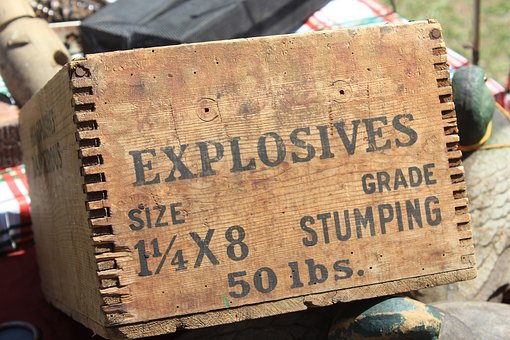 Mary Alford, aka Mrs Byron Alford has a unique place in history because she is the only woman ever to own a nitroglycerine factory.
Her husband was the one who built the factory back 1883 but she was not the type of wife to stay home and out of her husband's business. Mary was a trained accountant who studied about explosives and helped him build the factory.
Originally, Mr Byron Alford owned one of the largest oil fields in Pennsylvania which he began developing in the 1860's and by 1884 it was considered one of best producing fields in the country, producing over 83 percent of all oil produced in the United States. At this time, explosives were used in oil fields to improve extraction of the product rather than used in warfare.
So in 1883, they chose the perfect location to build a factory for production of explosives which they could use in their oil fields or sell to other companies. At the time, making nitroglycerine was crude and dangerous because they had to mix sulfuric acid, nitric acid, and glycerin which formed a milky colored liquid. the liquid was added to wooden container with eighteen inches of cold water at the bottom.
When the liquid hit the water, red fumes are produced sounding like the hiss of geese. If everything worked properly, the nitroglycerine at the bottom of the wooden casket, it was then poured into an eight quart container and sold for $8.00. They relied on the accuracy of thermometers of the time to maintain the temperatures needed for the whole process to be completed.
At the time, all nitroglycerine cans were transported by wagons because trains refused to allow them on board at all. She took over the day to day running in 1894 when his health began failing but once Byron Alford died, his wife became head of the factor. She ordered and paid for the chemicals, managed the payroll, monitored shipping, showed visitors around, and kept it running.
In fact, she did such a great job of running it that within one year, she'd production to 3,000 pounds of nitroglycerine and 6000 pounds of dynamite a day. By 1899, she had the title of "The only woman in the world who owns and operates a dynamite factory". This meant she was owned one of America's billion dollar oilfields.
On the other hand, she built wooden buildings because they were much cheaper to build and replace should something accidentally blow. At one point, an employee forgot and lit a match near the factory. She was noted for commenting that"you never knew when it would blow." and indeed the factory and her house which was only 80 yards from the factory both were damaged. Neighbors had to dig her, her husband, and their daughter out but they rebuilt the factory where it remained in the same place outside of Eldred, Pennsylvania until she died at the age of 77, in 1924. Her daughter took over the business until she died in 1947 at the age of 79.
Tuesday, October 2, 2018
Easy Breakfast Rolls
 A few weeks ago, I found a great breakfast rolls recipe that is super simple to make, uses few ingredients and tastes really good. I usually make a half a batch because there is only of me. I also give my neighbor one because he gently teases me at work and I get back by cooking food that makes him drool all over the place.......LOL.
I got the recipe from one of my cookbooks and I really enjoy them because they are not sweet. I often toast them and smear them with cream cheese, or add slices of cheese to make a sandwich lunch. I've even had them with fresh hot soup. These rolls are extremely versatile.
Breakfast rolls.
1/2 cup milk
1/2 cup water
1 tsp of yeast
1 tsp salt
4 cups of flour
Mix the milk and water together. Add in the yeast and salt. Add in 3 to 3 1/2 cups of flour, mixing it till its rather stiff. Place on floured board and knead. If the dough is sticky, knead in the remaining flour until its no longer sticky. Place it in an oiled bowl and cover with a towel. Let sit a few hours. till its risen. Take the dough out of the bowl, knead it a bit, then break into 8 equal pieces. Shape the pieces into roll like shapes about 2.5 inches by 1 inch. Place on a cookie sheet covered in parchment paper or is nonstick. Slide the cookie sheet in the refrigerator over night or for several hours. When you pull the rolls out, let them sit for 20 minutes. Cut a lengthwise slit in the dough, finish with brushing a bit of milk over all the rolls before baking at 450 degrees for about 15 minutes to 20 minutes. When done, pull out and cool a bit before eating.
I usually start them around dinner time, get them shaped just before I go to bed, and bake them first thing in the morning when I get up. I love the fresh rolls dripping in butter for breakfast. The cool thing is that you can heat them up in the oven or microwave. Although they are best the day they are baked, I've been known to freeze a few for later in the week. I thaw them the night before, heat them and voila a great breakfast.
I hope you get a chance to try the rolls. I adore them and make them on Friday night usually so I have rolls for the weekend. Yum, yum, yum. Let me know what you think, I'd love to hear. Have a great day.
Monday, October 1, 2018
Story Night
 This past Thursday evening, the school hosted a family night in the middle school/high school wing. The teachers and the home economics class provided snacks for the evening. The blackberry agutaq was absolutely fantastic. I know when I said blackberry, you automatically pictured the usual but these do not resemble a raspberry. They are actually a nice small round berry that is black.
There was also fry bread, a local version of Indian fry bread that is eaten with the agutaq along with brownies, cookies, regular bread and juices or tea. It was so good. After half an hour, we adjourned to one of the larger rooms to listen to two elders who came to share the older stories with us. One of the teachers planned to record the stories so they could be transcribed and turned into native language books for us in the classroom.
Traditionally, three stories are told and the evening is over. The two elders shared at least two stories with the group but it could have been three as my knowledge of the local language is quite limited. Fortunately, the gentleman running the evening gave abbreviated versions of the story.
One of the stories is always a ghost story and the one they told took place way back when families were strictly nomadic. They spent the winter inland and as spring arrived, they moved towards the sea to find food. By fall, they headed back inland till they reached the overwintering place. According to the elder, as people were heading towards the coast, stopping at fish camp, one man headed back to get something. He and his one dog who pulled his sled, arrived at night. They spend the night in one of the sod houses.
In the middle of the night, suddenly one corner shook as if something struck it, then another corner, another corner, and finally the last corner shook. He was scared when something tried to get in. His dog, quickly dug a hole in the dirt floor big enough for both he and his master. They both hid in the hole as the unknown creature came in. When the creature passed them, the man and his dog ran out the door and kept running until they passed the opening in the ground surrounding the village. Once they were safe, the dog began puking black goo from its stomach until it died. The man was sad but appreciated that the dog saved his life.
The other story the man translated was from the other elder. The area is surrounded by three specific groups of low mountains/hills. In this story, a man tied one rock to his back with ropes or something like that. He picked up one rock with his left arm and another with his right. He carried the rocks towards the coast but eventually, the rock tied to his back slipped off and landed on the ground to form one of the mountains. He stopped here and threw the rock in his left arm in one direction and the other rock in a different direction. Each of the rocks when they landed formed a different set of mountains. She said that is how the three local mountains formed.
It was wonderful and lots of fun. Both women did speak some English but the stories are better told in the local language so the children and others are able to keep the language alive. I really enjoyed it. This is only the first one of these due to happen this year.
I hope you enjoyed the stories I shared. Have a great evening. Let me know what you think, I'd love to hear.
Subscribe to:
Posts (Atom)